How Outbid Made $100K in 48 Hours: Inside the Viral Pay-to-Rank Leaderboard Phenomenon
An exhaustive breakdown of outbid.lol, how a 3-hour weekend project triggered a $14,000+ bidding war, crossed 1,000,000+ visitors in 48 hours, and redefined viral SaaS marketing.
In the fast-moving world of indie hacking and viral consumer applications, few experiments capture the internet's imagination quite like a brilliantly simple game-theory mechanism.
On August 19, 2026, independent software engineer and founder Jonathan Wilke launched outbid.lol, a website he built in approximately three hours. The premise was deceptively simple: a live, pay-to-rank leaderboard where anyone can outbid the competition to claim the #1 spot.
Within 24 hours, the site had amassed over 200,000 visitors and generated more than $21,000. By Hour 48, the platform crossed 1,085,781 visitors, generated upwards of $42,000 to nearly $100,000 in cumulative bidding volume, and recorded individual single bids exceeding $14,000.
Along the way, the platform crashed analytics providers, rejected a $100,000 instant buyout offer, dominated tech conversations across Silicon Valley and California, and triggered a massive wave of copycat clones.
Here is the complete, day-by-day technical, psychological, and financial breakdown of how the outbid phenomenon happened, why it worked so effectively, and what developers and marketers can learn from this modern reimagining of viral internet real estate.
What Is Outbid and How Does the Pay-to-Rank Mechanism Work?
At its core, outbid.lol is a real-time, gamified auction directory. Unlike traditional advertising networks or curated startup directories (like Product Hunt or directory listings), there are:
- No approval queues or editorial gatekeeping.
- No complex ad bidding algorithms or opaque quality scores.
- No recurring monthly subscriptions or complicated dashboards.
Instead, the ranking rules follow a single, transparent law of public competition.
The 4-Stage Pay-to-Rank Lifecycle
| Step | Stage | Mechanism & Strategic Outcome |
|---|---|---|
| 01 | Submission | Enter a product URL, startup landing page, or social handle with zero onboarding friction. |
| 02 | Initial Bid | Pay an entry fee starting at just $5 via instant Stripe checkout. |
| 03 | Live Placement | Instantly placed on the public leaderboard based strictly on total cumulative dollars paid. |
| 04 | The Outbid Duel | Challengers outbid the current #1 leader by paying at least +$1. The previous leader drops to #2 and can re-bid to regain top rank. |
The Core Rules of the Board
- The Starting Anchor: Anyone can submit a product URL, startup landing page, or social handle starting at just $5.
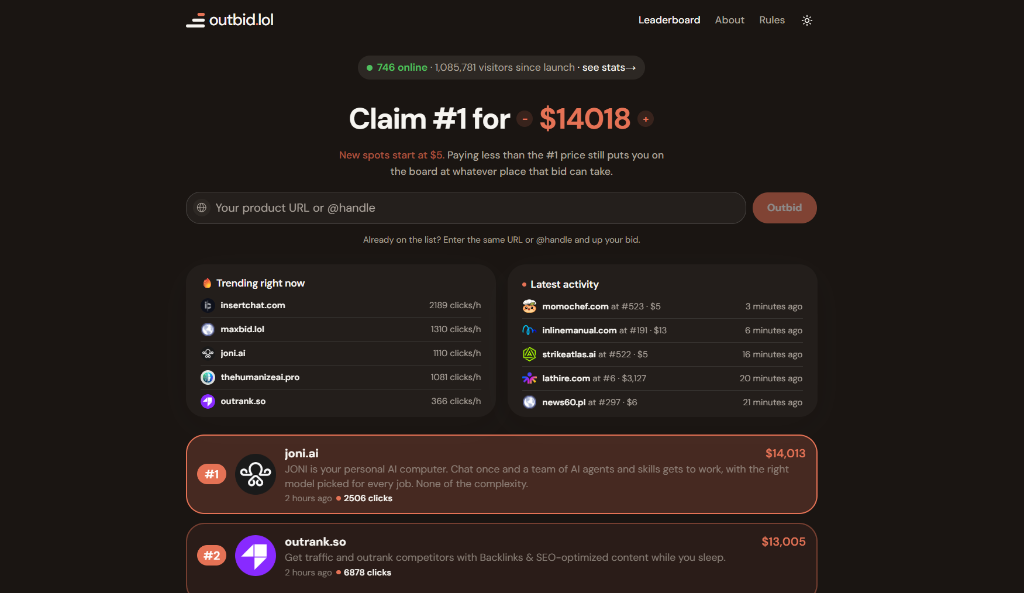
- Dynamic Hierarchy: Paying less than the #1 price still places you on the public leaderboard at whatever tier that dollar amount secures (for example, #191 for $13 or #523 for $5).
- The Outbid Condition: To claim the coveted #1 spot, your bid must exceed the current highest bidder by at least $1.
- Re-Bidding & Defense: If your project is pushed down the rankings, you can enter the exact same URL or handle to add to your existing bid total and reclaim higher ground.
- Real-Time Click Velocity: The platform publicly tracks and displays click metrics (such as clicks per hour) next to trending entries, providing immediate, verifiable social proof to advertisers.
Day-by-Day Chronology: The 48-Hour Frenzy from $1 to $14,000+
The viral velocity of outbid.lol unfolded in distinct phases over its first two days. Tracking the progression illustrates how low-stakes curiosity quickly evolved into high-stakes corporate marketing warfare.
Day 1 (Hours 0 to 24): From $5 Novelty to $21,000 Surge
When Jonathan Wilke first published the site on August 19, 2026, initial bids were small and playful. Early participants tested the system with $5 to $20 bids to see if the payment gateway and live leaderboard actually updated immediately.
| Time Elapsed | Milestone / Event | Top Bid | Total Revenue | Cumulative Traffic |
|---|---|---|---|---|
| Hour 1 | Launch on X; first $5 bids placed | $5 | ~$50 | 1,200 visitors |
| Hour 6 | Viral retweets across developer circles | $120 | ~$2,800 | 25,000 visitors |
| Hour 12 | First bidding duel between indie founders | $850 | ~$9,400 | 85,000 visitors |
| Hour 24 | Widespread adoption by AI SaaS startups | $3,500 | ~$21,000 | 200,000+ visitors |
During this initial 24-hour window, early bidders discovered an unexpected arbitrage: for a relatively small payment ($50 to $300), their products were receiving thousands of direct, highly engaged clicks from early adopters, founders, and investors visiting the site to watch the leaderboard move.
Day 2 (Hours 24 to 48): The Whale Bidding War and 1 Million Visitors
By the second day, the site achieved viral escape velocity. It was no longer just an indie experiment; it became a high-profile advertising billboard where tech startups competed for prime visibility.
48-Hour Price Escalation Milestone Tracker
| Milestone Stage | Top Spot Bid | Growth Velocity | Key Market Catalyst |
|---|---|---|---|
| Launch Hour 1 | $5 | Baseline Anchor | Initial launch by Jonathan Wilke on X |
| Hour 6 | $50 to $120 | +2,300% | Early adopters testing instant live updates |
| Hour 12 | $250 to $850 | +608% | First direct bidding battles between indie founders |
| Hour 24 | $1,200 to $3,500 | +311% | Crossing 200k visitors; AI startups entering the board |
| Hour 36 | $7,800 | +122% | Massive X viral reach and tech newsletter coverage |
| Hour 48 (Peak War) | $13,005 to $14,013 | +79% | High-stakes duel between joni.ai and outrank.so |
Key developments during the second 24 hours included:
- The Battle for #1: AI startups entered the arena with substantial marketing budgets. An aggressive bidding contest erupted between joni.ai and outrank.so, pushing the price for the top spot past $13,000 and eventually to $14,013 within hours.
- Viral Referral Loops: Every time a startup captured the #1 position, their founders proudly posted screenshots on social media to celebrate, driving fresh waves of followers back to the leaderboard.
- The $100K Acquisition Offer: As traffic exploded, the creator received an unsolicited buyout offer of $100,000 for the domain and codebase, which he publicly declined to let the organic game theory experiment continue running.
- Passing the 1,000,000 Visitor Mark: Live traffic counters recorded over 1,085,781 unique visitors with steady concurrent visitor counts hovering between 700 and 800 live users around the clock.
Traffic Analytics & Infrastructure Surge: Breaking the Trackers
Handling sudden, massive traffic spikes is a classic challenge for lightweight viral web apps. The rapid rise of the site provided a real-world stress test for both web infrastructure and analytics pipelines.
The Telemetry Migration to DataFast
Within hours of the launch, the initial analytics tracking provider hit severe rate limits and crashed under the sheer volume of simultaneous pageviews, websocket connections, and click-tracking events.
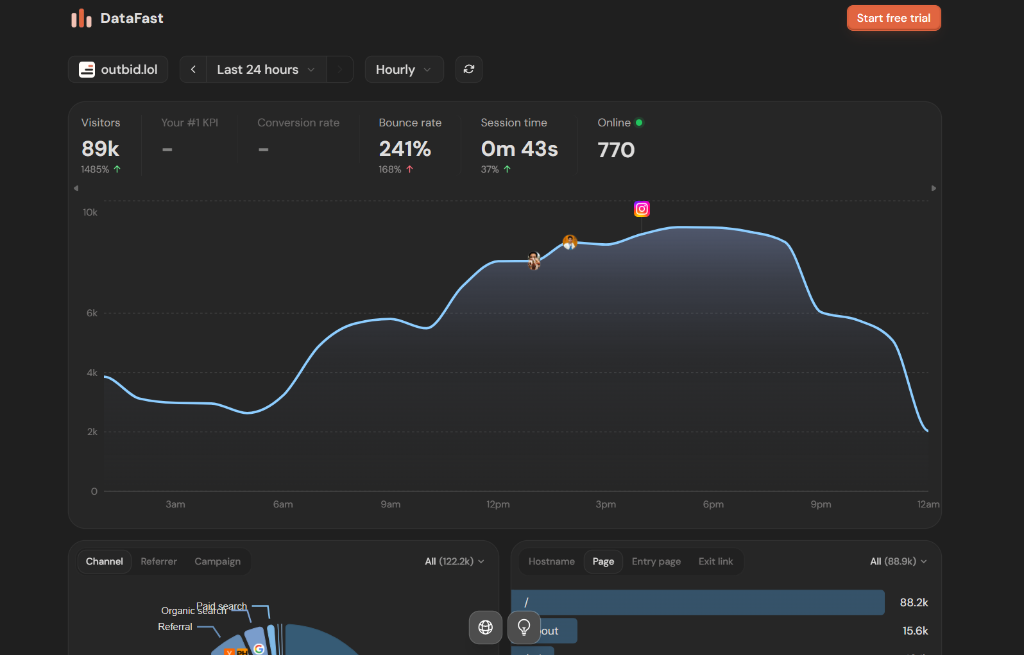
To keep live stats transparent and accessible, the project transitioned its analytics infrastructure to DataFast (datafa.st). Key metrics captured during peak 24-hour windows revealed:
- 24-Hour Unique Visitors: 89,000+ visitors logged on a single tracking view (a +1,485% daily surge).
- Concurrent Live Users: Sustained at 770+ active users simultaneously browsing and refreshing the board.
- Average Session Duration: 0m 43s, indicative of high-frequency check-ins where users repeatedly return to inspect ranking shifts.
- Click Velocity: Top-tier entries registered between 1,000 and 2,500 clicks per hour, delivering massive referral volume to participating products.
Why Outbid Went Viral: The 5 Psychological & Growth Triggers
The viral mechanics behind this pay-to-rank system were not accidental. The platform successfully combined several fundamental psychological drivers into a frictionless user interface.
The 4 Pillars of the Viral Outbid Flywheel
- Competitive FOMO & Status Signaling: Founders and marketing leads compete for top-tier exposure and bragging rights.
- Low-Barrier Entry ($5 Initial Bid): Tiny minimum financial commitments encourage widespread participation from anyone.
- Direct Social Proof & High Click-Throughs: Real-time traffic indicators confirm that holding top rankings generates immediate referral traffic.
- Network Effects & Continuous Re-Bidding: Dropping down the rankings compels previous leaders to bid again to protect their investment.
1. The Modern Evolution of The Million Dollar Homepage
In 2005, 21-year-old student Alex Tew created The Million Dollar Homepage, selling 1 million pixels of banner space for $1 each. It became an internet sensation, but its real estate was static: once bought, a pixel was locked forever.
Outbid took that premise and made it dynamic and fluid. By turning static real estate into an ongoing public auction, spots are never permanently locked. Every position is constantly vulnerable to being claimed by the next bidder, creating an infinite game of king-of-the-hill.
2. Zero-Friction Conversion Funnel
Most advertising platforms require registration, credit card verification, tax documentation, campaign setup, ad creative approval, and budget scheduling.
On this leaderboard:
- No account registration is required.
- You paste a link and type a short description.
- You complete a one-click Stripe payment.
- Your project appears live on the leaderboard in under 10 seconds.
Eliminating 100% of onboarding friction turned high-intent impulse into immediate transaction revenue.
3. Public Ego and Status Signaling
In the technology and venture startup ecosystem, distribution is the hardest challenge. Founders are constantly looking for creative ways to demonstrate traction, boldness, and market presence.
When a founder spends $5,000 or $14,000 to reach #1, they aren't just buying clicks: they are buying bragging rights, brand prestige, and a compelling narrative that they can immediately share with their social audience.
4. Transparent, Real-Time ROI
Many viral novelty sites fail because early participants feel like they received nothing in return.
By adding a public "Trending right now" ticker showing verifiable clicks per hour (e.g., 2,189 clicks/h for leading projects), participants could immediately calculate their effective Cost Per Click (CPC) and justify higher bids.
5. Spectator Entertainment (The Gladiator Effect)
A critical insight of this model is that the majority of visitors never bid at all; they come to watch the spectacle.
Seeing whether an underdog startup will outbid a venture-backed competitor creates dramatic tension, turning a simple business directory into spectator entertainment that users refresh multiple times per day.
Outbid vs. Traditional Tech Advertising: An ROI Comparison
How does paying thousands of dollars for a temporary #1 spot on a viral leaderboard compare to standard B2B/SaaS advertising channels?
| Channel | Typical Cost Structure | Setup Time | Primary Audience | Longevity of Impact |
|---|---|---|---|---|
| Viral Pay-to-Rank (Outbid) | $5 to $14,000+ (One-time bid) | ~30 seconds | Founders, Developers, Tech Investors, Early Adopters | Intense spike (48 to 72 hours) + High viral secondary PR |
| Google Search Ads (CPC) | $3.50 to $15.00+ per click | Hours / Days | High-intent searchers looking for specific solutions | Linear with continuous ad spend |
| Product Hunt Launch | $0 (Organic) or $4,000+ (Sponsored) | Weeks of prep | Tech enthusiasts, product hunters | 24-hour homepage window |
| Tech Newsletter Sponsorship | $1,500 to $10,000 per issue | Days / Weeks | Targeted industry subscribers | Single email drop |
| Twitter / X Sponsored Ads | $1.50 to $6.00 per engagement | Hours | General social demographic | Dependent on continuous budget |
For the top-ranking projects, the calculated return went far beyond direct leaderboard referrals:
- Second-Order Press Coverage: Leading projects were featured in dozens of tech newsletters, blog posts, YouTube summaries, and social roundups.
- Brand Association: Being associated with the top spot of the most talked-about tech event of the week established instant authority and brand recall.
The Copycat Wave: Why Clones Failed to Defeat the Original
The immediate financial success of the platform triggered an intense gold rush among developers. Within 24 to 48 hours, at least a dozen direct clones and derivative platforms launched across the internet, including:
- maxbid.lol
- claimrank.lol
- watchbid.lol
- overbid.lol
- outrank.lol
Some attempted to introduce novelty twists (such as hourly decay timers, crypto payouts, or category-specific directories). However, almost none achieved a fraction of the original site's revenue or cultural traction.
Why Clones Failed: Structural Comparison
| Factor | Outbid (The Original) | Clone Platforms | The Winning Advantage |
|---|---|---|---|
| Audience & Liquidity | 1,085,000+ verified visitors | Near-zero organic traffic | Bidders only spend money where real human attention exists. |
| Cultural Narrative | Authentic viral experiment & meta-commentary | Viewed as derivative cash grabs | The tech community supports original creators, not quick copycats. |
| Attention Concentration | 770+ concurrent live spectators | Fragmented, low-retention visits | Audiences follow one central high-stakes leaderboard arena. |
Why the Original Remained Undefeated
- The Liquidity Moat: A pay-to-rank leaderboard is a two-sided network. Bidders will only pay real money if there are hundreds of thousands of eyeballs watching. Because the original platform captured the initial million-visitor audience, it held 99% of the economic liquidity.
- First-Mover Narrative: The tech community celebrated the original site as a witty, meta-commentary on SaaS marketing. The subsequent clones were viewed merely as rent-seeking cash grabs, failing to generate organic retweets or community enthusiasm.
- Winner-Take-All Attention Economy: Social attention on the internet is fiercely concentrated. People enjoy following one central leaderboard with high stakes; they have no incentive to split their attention across ten fragmented copies.
Technical Anatomy: How to Build a Real-Time Viral Bidding Engine
Building an application that can scale from zero to one million visitors in two days while processing thousands of dollars in real-time payments requires careful architectural choices.
Recommended Tech Stack for High-Concurrency Bidding
Frontend: Next.js (App Router, React Server Components)
Styling: Tailwind CSS
Database & State: Supabase / PostgreSQL or Convex (Real-time subscriptions)
Payments: Stripe Hosted Checkout & Webhooks
Caching: Edge CDN + In-Memory LRU Cache
Telemetry: DataFast / PostHog
1. Atomic Database Transactions & Concurrency Handling
When two users attempt to outbid each other simultaneously, database race conditions must be prevented using atomic row updates or serializable transactions:
// Conceptual atomic bid verification in TypeScript / SQL
export async function processBid({
  projectUrl,
  newAmount,
  stripeSessionId,
}: {
  projectUrl: string
  newAmount: number
  stripeSessionId: string
}) {
  return await db.transaction(async (tx) => {
    // 1. Fetch current top record with row-level lock
    const currentTop = await tx
      .select()
      .from(leaderboard)
      .orderBy(desc(leaderboard.totalPaid))
      .limit(1)
      .for("update")

    // 2. Verify payment session status with Stripe
    const session = await stripe.checkout.sessions.retrieve(stripeSessionId)
    if (session.payment_status !== "paid") {
      throw new Error("Payment unverified")
    }

    // 3. Upsert bidder's total paid amount
    await tx
      .insert(leaderboard)
      .values({
        url: projectUrl,
        totalPaid: newAmount,
        updatedAt: new Date(),
      })
      .onConflictDoUpdate({
        target: leaderboard.url,
        set: {
          totalPaid: sql`${leaderboard.totalPaid} + ${newAmount}`,
          updatedAt: new Date(),
        },
      })
  })
}
2. Edge Caching vs. Real-Time WebSockets
To handle over 10,000 requests per minute without overloading backend databases:
- The static HTML shell should be served directly from Edge CDN nodes.
- Leaderboard rankings can be updated via lightweight WebSocket events or Server-Sent Events (SSE), polling an edge-cached JSON snapshot revalidated every 2 to 5 seconds.
- Click counters should be batched in Redis or in-memory queues before flushing to persistent storage in bulk.
5 Actionable Lessons for Indie Hackers and Engineers
The viral success of outbid.lol offers clear takeaways for developers building modern web products:
1. Extreme Simplicity Wins
You do not need a 6-month product roadmap to build something impactful. A single page with one clear interaction mechanism, built in 3 hours, can outperform multi-featured applications if the core value proposition is instantly understood.
2. Build In Public and Ride the Meme Cycle
The creator actively shared transparent revenue charts, visitor spikes, and humorous updates on social media. Building in public turns your users and followers into co-conspirators who actively root for the project's success.
3. Gamify User Competition
Whenever users can compete against one another for status, rank, or visibility, their engagement shifts from passive consumption to active investment.
4. Remove Every Barrier to Payment
Do not force signups, password confirmations, or email verifications when collecting payment. Streamline the checkout flow to a single, frictionless action.
5. First-Mover Advantage in Viral Mechanics Is Decisive
When an original idea strikes, execution speed is everything. Launching first allowed the platform to secure all the cultural momentum before copycats could establish a foothold.
Frequently Asked Questions (FAQ)
What is Outbid?
Outbid (specifically outbid.lol) is a viral, pay-to-rank public leaderboard created by developer Jonathan Wilke. Users pay real money to rank their websites, apps, or social media handles on the board, where the highest total bidder holds the #1 position.
How much money did Outbid make in its first 48 hours?
In its first 48 hours, the platform crossed over 1 million visitors and generated tens of thousands of dollars in cumulative bidding revenue (ranging from $42,000 to near $100,000 in projected transaction volume), with individual single bids reaching $14,013.
Can you reclaim your spot if someone outbids you?
Yes. If another project places a higher bid and pushes you down the rankings, you can re-enter your existing product URL or handle to increase your cumulative bid total and reclaim your rank.
Who is the creator of Outbid?
The site was created by Jonathan Wilke, an independent developer and entrepreneur also recognized as the creator of supastarter, a popular SaaS development boilerplate.
Why did the clones fail to compete with Outbid?
While dozens of copycat platforms were launched immediately after its viral surge, they lacked the massive traffic liquidity and social narrative that made the original platform valuable to advertisers. In pay-to-rank models, bidders concentrate exclusively on the platform with the highest number of active viewers.
Enjoyed this breakdown? Explore more deep dives on web architecture, Next.js engineering, and performance optimization on our blog or check out our featured projects.